
HORIZONTAL DIRECTIONAL DRILLING (HDD)
What is Horizontal Directional Drilling (HDD)?
Horizontal Directional Drilling commonly referred to as HDD is a trenchless method of installing underground pipelines such as water lines, sleeves, sewer lines, fiber optic sleeves, gas lines and storm water conduits known as the product pipe.
When compared to open excavations the trenchless method of HDD minimizes the amount of excavations needed to install new infrastructure, during the HDD works only a launch pit and receive pit is required.
The launch pit is used as a working pit in order to attach the drill head and various back reamers and finally to launch and pull the new product pipe through to the reception pit. The reception pit is also used as a working pit to detach the drill head and various back reamers.
The pipe product used is recommended to be HDPE (High Density Poly Ethylene) due to its flexibility, strength and durability.
HDD Process
The HDD Rig is moved into position, the depth of the line has to be taken into consideration. The deeper the new product pipe to be installed is the further the Rig will be set from the reception pit (standing position).
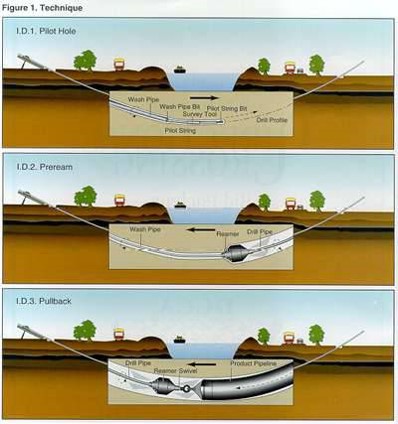 The HDD operator begins the drill from the standing position of the machine through to the reception pit. Here the HDD assistant will check and confirm the drill head is at the correct depth.
The pilot bore: this is the first drill where an approximate 110mm diameter bore is drilled connected by 3m long hollow drilling rods. This is the most crucial drill as the rest of the HDD process will follow this bore path. Constant detecting of the bore path may be required, especially for lines that need to be at a gradient.
Detecting is done by the HDD assistant walking (at ground level) with a detector and relaying information about the drill path (location, inclination, depth and direction) back to the HDD operator. For this reason traffic accommodation is crucial if the line is crossing over a road.
Upon the successful completion of the pilot bore the back reaming process will then commence. The back reaming process will be done in increments dependent of the new product pipe to be installed. Below is an example of the increments that would be required for a 400mm HDPE sleeve pipe of approximately 45 meters long:
• The first back reamer will have an outside diameter of 220mm.
• The second back reamer will have an outside diameter of 320mm.
• The final back reamer will have an outside diameter of 450mm.
• Once the final back reamer has been completed, the pipe will be attached to the 450mm by means of a bull nose and swivel and the 400mm sleeve will be pulled through to the reception pit.
Throughout the HDD process a mixture of water and bentonite, known as a mud mix may be required. Bentonite is a chemical used to keep the integrity of the bore path. The mud mix aids in both removing the drilled spoil form the bore path into the reception pit and reduces the surface friction for the new pipe product to be pulled through. The mud mix is delivered by means of nozzles which are located on the drilling head and reamers. Different mud mixes are used for different ground conditions.
CONCLUSION
This concludes the HDD drilling process, and the tie ins/back filling may then take place. There are no environmental impacts when referring to the drilling aids, all chemicals and/or additives used during the HDD drilling process will comply with the occupational Health and Safety Act, MSD’S of these aids (chemicals or additives) will be kept on site by the drilling operator for approval by the client.